...accepting we, still, don’t know as much as we think we do accept that we,…

Applying Habermas’ Communicative Action and the Public Sphere to Residential Child Care
Introduction
For some years NCERCC has been interested in writing a piece on Habermas and Residential Child Care believing these ideas provided at least an opportunity for reflection, and maybe a foundation for doing things differently.
With the death of Jurgen Habermas being announced we spent a while getting some thoughts together as means of remembering.
Please click on our download links below:
Policy: Communicative Practice and Democratic Participation in Residential Child Care
Training Module: Communicative Practice & Democratic Participation in Residential Child Care
7 Handouts: Communicative Practice & Democratic Participation in Residential Child Care
Applying Habermas’ Communicative Action and the Public Sphere to Residential Child Care blog
Residential child care is one of the most complex social environments we create: a place where young people live, learn, heal, and grow; where adults work, care, and make decisions; and where the state’s authority meets the intimate realities of childhood. Because of this complexity, it is also a setting where power, voice, and meaning are constantly negotiated. Habermas’s ideas—particularly communicative action and the public sphere—offer a powerful lens for reimagining how residential care can become more democratic and relational.
When translated into practice, they can reshape the culture of a children’s home, strengthen relationships, and create conditions where children and their grown-ups participate meaningfully in the life of the home. They help us move from a system that manages children to one that engages them as citizens of their own lives.
Communicative Action: A Foundation for Democratic Care
Habermas’s idea of communicative action centres on dialogue aimed at mutual understanding rather than control. In residential child care, this is transformative. Communication can become instrumental: adults give instructions, enforce rules, or extract information. Communicative action invites something different—conversations grounded in: authenticity respect for the other’s perspective, a willingness to be changed by what we hear, shared reasoning rather than imposed authority
How this might play out in a children’s home
Everyday interactions
When grown-ups approach conversations with young people as opportunities for shared meaning-making, the tone of the home shifts. Instead of “How do I get this child to comply?”, the question becomes “How do we understand each other and act together?”. This supports relationally informed practice, reduces conflict, and builds trust.
Decision-making
Communicative action encourages adults to explain the reasoning behind decisions, invite critique, and negotiate outcomes. This is especially important in residential care, where young people often feel decisions are made about them rather than with them.
Repair and conflict resolution
Rather than relying on sanctions or behavioural management, communicative action supports restorative approaches. Conflicts become opportunities for dialogue, understanding, and relationship-building.
Professional culture
Among staff, communicative action fosters reflective practice, reduces hierarchical defensiveness, and encourages collaborative problem-solving. It supports a culture where workers can challenge unsafe or unethical practice without fear.
In short, communicative action helps create a home where communication is not a tool of control but a medium of shared life.
The Public Sphere: Creating Spaces for Voice and Participation
Habermas’s public sphere is a space where people come together to deliberate about matters of shared concern. In residential child care, the idea of a public sphere helps us imagine the home as a mini-democratic community—a place where young people and adults participate in shaping the norms, routines, and decisions that affect them.
What does a public sphere look like in a children’s home?
House meetings as genuine deliberative spaces
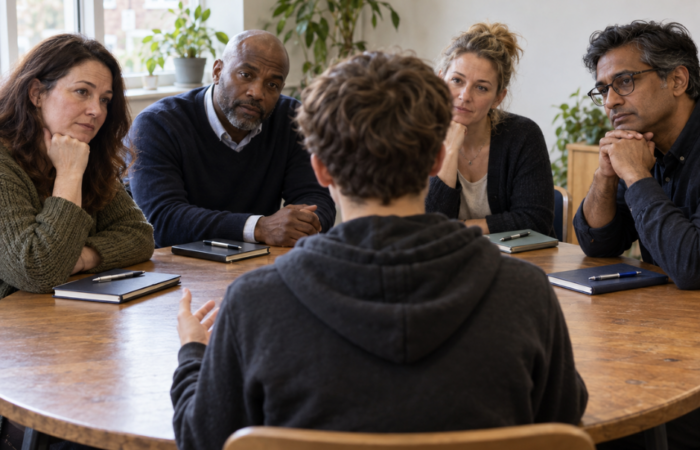
Many homes have house meetings, but they often become administrative rituals. A Habermasian approach would transform them into: open forums for discussion; spaces where young people set the agenda; places where disagreements are explored, not shut down; arenas where staff and young people reason together as equals
This doesn’t mean abandoning adult responsibility; it means exercising it democratically.
Participation in care planning
Young people’s involvement in their own plans has often been evaluated as tokenistic. A public-sphere approach insists that young people must be active participants in shaping the goals, strategies, and expectations that define their care.
Residential child care worker participate!
Residential workers often feel marginalised in organisational decision-making. Creating internal public spheres in homes can mean team forums, reflective spaces, participatory policy development that strengthen professional agency and improved practice.
Community engagement
The public sphere also extends beyond the home. When residential settings build relationships with neighbours, schools, local groups, and civic institutions, young people gain access to wider networks of belonging and influence.
Bridging the Two: Communicative Action as the Practice of the Public Sphere
Communicative action is the method; the public sphere is the space. Together, they create a democratic culture of care.
In practice, this means:
- Young people’s voices are not symbolic—they shape decisions.
- Adults do not hide behind policy—they explain, negotiate, and reflect.
- Conflicts are not suppressed—they are worked through collectively.
- Power is not denied—it is shared and made transparent.
- The home becomes a living community, where practice is not allowed to become institutionalised.
This is especially important in residential child care, where young people have often experienced disempowerment, exclusion, and trauma. A democratic communicative culture helps restore agency and dignity.
Why This Matters: Ethical, Developmental, and Political Implications
Ethical
Residential care involves profound moral responsibilities, as does all parenting. Communicative action ensures that decisions respect the autonomy and humanity of children. It resists the drift toward bureaucratic or authoritarian practice.
Developmental
Young people learn social skills, emotional regulation, and identity through interaction. A communicative environment supports: emotional literacy; conflict resolution; critical thinking; self-advocacy; democratic participation
These are essential life skills.
Political
Residential care is a microcosm of society. When young people experience democratic participation in the home, they are more likely to participate in civic life beyond it. Conversely, when they experience control and exclusion, they internalise those patterns.
Practical Strategies for Embedding These Ideas
Here are concrete ways to operationalise Habermas in residential care:
✔️ Establish deliberative house meetings
With rotating chairs, shared agendas, and real decision-making power.
✔️ Train staff in dialogic practice
Including active listening, nonviolent communication, and reflective dialogue.
✔️ Create shared norms collaboratively
Rules become co-authored agreements rather than imposed expectations.
✔️ Use restorative approaches
Conflicts become opportunities for understanding and repair.
✔️ Build participatory care planning
Young people help define goals, strategies, and measures of success.
✔️ Develop organisational public spheres
Regular forums where workers and young people influence policy and practice.
✔️ Strengthen community connections
Expanding the public sphere beyond the home.
Conclusion: Toward a Democratic Culture of Care
Applying Habermas to residential child care is not about importing abstract theory—it is about transforming the everyday life of the home.
Communicative action helps create relationships grounded in respect, understanding, and shared meaning.
The public sphere helps build structures where young people and workers participate in shaping their environment.
Together, they support a vision of residential care as a democratic community, a place where young people experience agency, dignity, and belonging
In a sector often dominated by risk management, bureaucracy, and power imbalances, Habermas offers a radically hopeful alternative: a model of care built on dialogue, participation, and the shared construction of a good life.
Related Posts