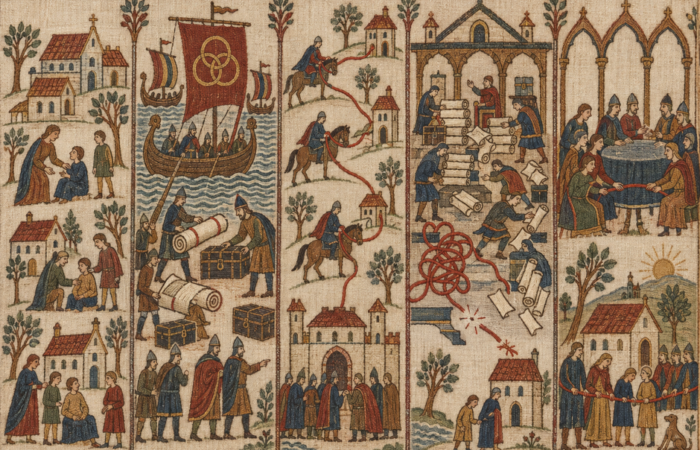
The Bayeux tapestry exhibition has just opened and is attracting a lot of interest. It…

Starting the necessary critical thinking about children’s social care
Both demand and supply in children’s social care are gravitating towards larger entities; large providers, regional care cooperatives.
Both are features that have arisen without prior theorisation as to the effects in child care or in administrative/financial terms.
Regional care coops might be portrayed as a balance to large providers in commercial terms.
This judgement being made after the fact of the effects of the size of some providers and their seeming impregnability as evidenced in profits.
The positive side has been balanced by Ofsted noting the maintaining of quality through the use of quality assurance of monitoring, in-house consultancy, leadership support, and consistency of workforce development. These are to be expected in any scaled up mainstream provision.
Multiple high level co-occurring interacting needs rarely are provided for at scale, but this criticism of their absence from large providers combines with profits to a negative evaluation of what they are providing, not the ‘right homes in the right place.’
Condemnatory appraisal, for a purpose of achieving hegemony, is not the critical thinking necessary. It is reactive and aimed to be destructive whereas the critical thinking necessary is proactive and constructive.
We need to have engaged in critical thinking beforehand.
Maybe the behavioural nudge economists did so. If this is the case it needed more experts in the room to get closer to incorporating details of the present and how they might develop. This is now happening in those areas who are not pathfinders. More is necessary.
Behavioural nudge science is contextual, they advise there is always ‘something’ to be done to get closer to the undeclared goal.
The experts needed know what is to be done. They can go further and can think what happens next, after next, after next; anticipation through expertise and experience being applied. In the rushing to set up regional care coops, to counter providers, who would/could have thought that the reaction would/could be providers would not turn up? Critical thinkers would.
It is not too late to start to think critically.
NCERCC uses the term in all senses, critically as at a time of potential crisis, and as a reflective analytical practice that has the method thesis: antithesis: synthesis.
The absence of critical thinking needs filling.
In the light of forthcoming election results and local government reform now might not be the time to push onwards, but to think. Don’t do something without thinking. Do nothing – think.
Here’s some relevant critical thinking
George Ritzer’s “The Globalization of Nothing” (2003) analyses how homogenised, empty forms (“nothing”), like chain restaurants, standardised products, the internet, regional care coops, large providers —are spreading globally, often replacing unique, local, or content-rich forms (“something”). It links this trend to “grobalisation” (corporate-driven expansion) with another Ritzer concept of McDonaldisation.
Key Concepts of Ritzer’s Framework:
- Nothing (Empty Forms): Lacks distinct, local content; centrally conceived and controlled (e.g., credit cards, fast-food franchises, generic shopping malls).
- Something (Distinctive Forms): Rich in unique, locally produced content (e.g., a local coffee shop, a handmade item).
- Grobalisation: The imperialistic, expansive force of American-led corporations, which drives the spread of “nothing”.
- Glocalisation: The tailoring of global, empty forms to local tastes, creating “something” or a hybrid of both.
Key Themes and Arguments:
- The Trend: Ritzer argues that the world is increasingly dominated by “nothing,” as these forms are cheaper, easier to produce, and more readily accepted across cultures.
- Paradox: While he critiques the loss of local “something,” Ritzer notes that “nothing” is not always bad (e.g., reliable, standardized, and safe products), nor is “something” inherently good (e.g., a local, distinct culture could be harmful).
The point is made there is a tension between the rapid, top-down spread of standardized (empty) forms and the localised (something) alternatives.
Ritzer uses a 2×2 matrix to categorise social forms based on two scales: Something vs. Nothing and Glocal vs. Grobal.
This creates four distinct quadrants that explain how products and experiences exist in a globalised world:
1. Glocal Something (The Unique/Local)
This is the “ideal” for many—unique, locally controlled, and rich in content.
- Characteristics: High quality, culturally specific, and often artisanal.
- Examples: A family-owned bistro using local ingredients, a handmade craft from a local market, or a specific regional dialect.
2. Glocal Nothing (The Localized Generic)
These are standardised forms that have been slightly tweaked to fit a local culture.
- Characteristics: Centrally conceived but adapted to local tastes.
- Examples: A McDonald’s “McSpicy Paneer” in India or a localised version of a global TV franchise.
3. Grobal Something (The Global Unique)
These are unique or high-content items that have been successfully marketed to the entire world.
- Characteristics: Distinctive and high-quality, but distributed on a massive, imperialistic scale.
- Examples: A touring performance with deep artistic value, or high-end luxury brands.
4. Grobal Nothing (The Mass Generic)
This is Ritzer’s main concern—the “void” that is taking over the world because it is cheap and easy to export.
- Characteristics: Mass-produced, standardised, and lacking any local soul or connection.
- Examples: Suburban retail parks, automated call centers.
Application to Children’s Social Care
In the context of children’s social care, George Ritzer’s four quadrants describe the tension between standardised, corporate-style management and personalised, relationship-based practice.
Scholars like Donna Dustin describe this shift as the “McDonaldisation of Social Work,” where the focus moves from qualitative human support to quantitative data and efficiency.
1. Grobal Nothing (The Standardised System)
This quadrant represents the “industrialised” side of social care, often driven by government mandates or large private providers seeking efficiency.
- Characteristics: High use of templates, tick-box assessments, and “non-people” (workers following rigid scripts rather than using professional judgment).
- Examples: Generic risk assessment software used across entire regions, “formulaic” care plans where the text is largely copied from other files, or large-scale homes providers that operate with identical rules regardless of the child’s needs.
2. Glocal Nothing (The Localised Script)
These are global management models that have been “tweaked” to fit local or specific local requirements but remain fundamentally standardised.
- Characteristics: standards or “best practice” models that are adapted for a specific paperwork but still demand high levels of predictability and control.
- Examples: A local authority adopting a nationally standardised “Early Help” framework but adding its own specific branding or local referral forms.
3. Grobal Something (The Global Professional Standard)
This refers to high-quality, unique professional standards and human rights frameworks that are recognised and applied globally.
- Characteristics: Deeply meaningful content (child-centred values) that is spread to improve safety and well-being.
- Examples: child care standards providing a framework but is rich in “something” (human rights and dignity) like internationally recognised models of care.
4. Glocal Something (The Relationship-Based Practice)
The ‘ideal’ of social work: unique, deeply personal interventions tailored specifically to an individual child.
- Characteristics: Highly personal, adapted care informed by the unique relationship between a social worker and a family, or residential worker and child
- Examples: A worker who uses their professional discretion to design a bespoke care for a teenager rather than relying on a standard menu of services.
Impact on Practice:
The “grobalisation of nothing” in social care is often criticised for leading to dehumanisation or institutionalisation, where children are seen as data points or ‘cases’ rather than individuals.
The “grobalisation of nothing” in social care is often criticised for leading to dehumanisation or institutionalisation, where children are seen as data points or ‘cases’ rather than individuals.
Critics argue that the more the system moves toward “nothing” (efficiency and predictability), the harder it becomes for workers to provide “something” (meaningful, transformative relationships).
Related Posts