The Bayeux tapestry exhibition has just opened and is attracting a lot of interest. It…
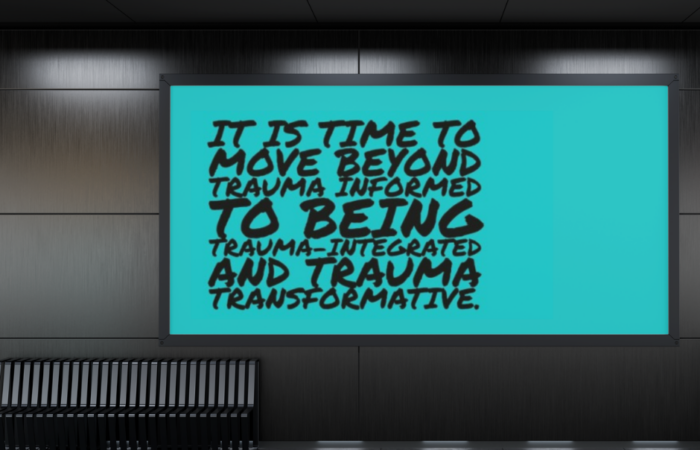
Being transformative – we need to move from your model of care to your theory of change.
Most providers/homes will be able to answer, ‘What is your model of care’? They wear it as a badge of what we do. They can tell you.
Much more incisive is to ask, ‘What is your theory of change?’
That shifts things.
Show me how you achieve change with children.
Being transformative
Being transformative brings a significant new orientation: They have thought of and committed themselves not to a model of care but to a theory of change that realistically supports how children, young people and families. The service and its staff believe that the effects of trauma can be changed. They represent hope to service users and the community.
How did we get to this insight?
Having published in June 2026 ‘Distinguishing Residential Child Care, Therapeutic Child Care, Treatment, and Trauma-informed Residential Care’ Distinguishing Residential Child Care, Therapeutic Child Care, Treatment, and Trauma-informed Residential Care – NCERCC we were prompted by our wide international reading to write more about trauma.
We highly regard CETC Centre for Excellence in Therapeutic Care in Australia and rediscovered some gems regarding trauma.
This trail explains how we got from models of care to theory of change.
Lauren Thomas in 2019 enquires What is trauma? Learn – What is trauma? – Learn
She writes ‘Depending on who or what you read, trauma will be defined in a variety of ways. Is it simple or complex? Developmental, relational or attachment oriented? Within the field of childhood trauma, we have a multitude of definitions and sub-categories that can be quite confusing for practitioners.
That is a good description of the use of the term ‘trauma’ in English children’s social care.
We loved the way Lauren is direct saying ‘…it is important that we all know what we are on about’.
Trauma
Trauma is ‘emotional, psychological and physiological’ effects of an event and experience.
Lauren then distinguishes gradations trauma.
Simple trauma
Is overwhelming and painful, but not simple! They might be single instances (an accident, an earthquake, etc) not complicated by being found in relationships core to survival, by being likely to be associated with stigma, or being experienced repetitively over time. The child has supportive close relationships who respond.
Complex trauma
Complex trauma involves multiple longer lasting incidents involving interpersonal threat, violence, and violation. There is almost always associated with stigma and a sense of shame made more complicated when experienced in relationships, from those we might look to assist our survival or recovery. Responses might be experienced as disconnected to the child’s experience and involve blaming and disempowering the targets of the violence. Examples can include exploitation, abuse, bullying, violence.
Developmental trauma
‘Developmental trauma’ occurs through being neglected, abused, forced to live with family violence or experience high parental conflict in the context of separation or divorce undermining the stability and predictability of their connections with others.
Thanks, Lauren, for these helpful clarifications.
In 2015 Janise Mitchell wrote ‘9 plain english principles of trauma-informed care’
She was responding to the recognition that trauma literature can be challenging to decipher and make relevant to the ways in which children that have experienced abuse and neglect can be effectively supported. Here’s a summary.
Learn – 9 plain english principles of trauma-informed care – Learn
- Trauma significantly alters baseline physiological arousal levels in children.
Be attentive to helping a child feel and be safe. Focus on appropriate sensory stimulation. Be ‘present’, in communication, connected. Reduce your reactivity.
- Trauma reduces cortical capacity to regulate subcortical activation in children.
Carers understand a traumatised child can find it difficult to use reasoning and logic to modify their behaviour or reactions, rule-based expectations do are not containing enough. There is likely little learning from consequences, particularly when they are in a heightened state. Recovery comes through predictable repeated interactions, like play.
- Trauma disrupts memory functioning in children.
Support children by using visual and mnemonic cues to prompt short term memory rehearsal and recall, repetition of episodic and narrative structures and the establishment of routines to structure behavioural rehearsal. Practice these in different situations and with different people so the child feels themselves an expert.
- Trauma disconnects children from relational resources that can mitigate its effects.
Consistency, nurture and predictability in daily relationships. Knowing that each interaction acts to develop ways of experiencing the world and relationships that counteract previous attachment patterns. Attuned communication with children is a core competency for caring for children with trauma backgrounds.
- Trauma restricts the attentional capacity of children.
Redirect attention away from past trauma-oriented activation to the here and now.
- Trauma based behaviour is functional at the time in which it develops as a response to threat.
Know the purpose and meaning of the particular trauma-based behaviour in this child. What function is it performing for the child?
- Trauma limits children’s response flexibility and adaptability to change.
Understand triggers. Be the ‘intentional resource’ for the child helping recognise and divert from triggering events. Prepare a child before even the smallest change. Predictability and routine are good and can assist with preparation for the flexibility needed in daily living.
- Trauma undermines identity formation in children.
Resource and reinforce, praise, a positive sense of self, nurture the emerging self-identity.
- Trauma diminishes social skills and isolates children from peers.
Social situations can be stressful so role model social skills and respectful interactions. This will help create a network of relationships.
Thanks Janise
What comes after trauma-informed practice? asks Joe Tucci (in 2016)
Learn – What comes after trauma-informed practice? – Learn
In England this is timely to place at the forefront of our thinking. In England might ‘trauma informed’ be in danger of becoming routine? Back to Lauren ‘…it is important that we all know what we are on about’. That this may be happening we can understand through the words of Joe Tucci, we are pulled ‘towards a fragmentation of approaches, the emphasising of pathology and the failure to appreciate the strengths inherent in children’s culture and the collective power of their community. Fragmentation itself is a product of trauma (Siegel).’
He continues with observations that are so relevant to England today, ‘The way forward is to reflect and conceptualise clearer models of integration. We need models that resource practitioners towards more analysis and less description. We need models that create principles that orient us to shared and mutual ways of working. And we need models that centralise approaches that not only address the current needs of children but also understand and meet the echoes of needs that have remained unmet in their past because of the trauma they have experienced. This future is a move beyond being trauma informed to being trauma-integrated and trauma transformative.
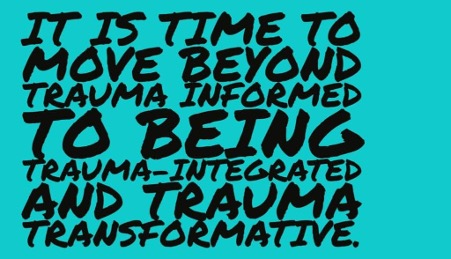
He urges us to ‘move beyond this current conceptualisation to a way of working that is trauma integrated, where services have used the knowledge base about trauma and will have fused these principles with their own mission and vision. Trauma is not separate to the operations of the service; it is at the centre. Trauma integrated services focus away from individual trauma symptoms. They interact with the individual as a whole person and as part of a network of relationships that are strengthened as the basis for change.
Trauma transformative
Being trauma transformative brings a significant new orientation: They have thought of and committed themselves not to a model of care but to a theory of change that realistically supports how children, young people and families. The service and its staff believe that the effects of trauma can be changed. They represent hope to service users and the community.
Thanks Joe.
Related Posts