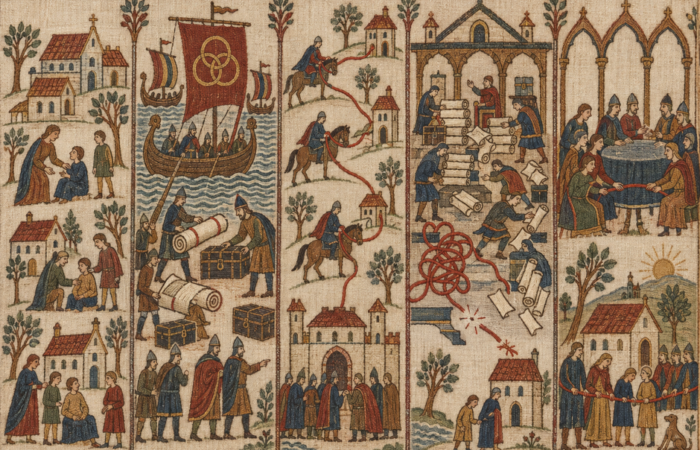
The Bayeux tapestry exhibition has just opened and is attracting a lot of interest. It…

Learning from NATS for RCCs – I’m children’s commissioning – fly me?
The massive NATS air traffic control system breakdown serves as a powerful cautionary tale for the rollout of Regional Care Cooperatives (RCCs) in children’s social care.
RCCs pool multiple local councils, health services, and police forces into giant regional systems to plan and buy care placements.
The similarities between a potential RCC failure and the NATS meltdown come down to the dangers of hyper-centralisation, system complexity, and fragile back-up processes.
1. The “Single Point of Failure” Risk
- The NATS Reality: A single, exceptionally rare error in a flight plan caused the core automated system to shut down. Because the entire UK airspace relies on this centralised system, one localised digital glitch instantly grounded thousands of flights nationwide.
- The RCC Parallel: . If the central regional database or data-sharing system crashes, the disruption will not just affect one local authority —it could freeze children’s placements, triage, and cross-agency tracking across an entire portion of the country all at once.
The learning point – by shifting care placement responsibilities from individual councils to large regional hubs, a potential massive single point of failure is created.
2. Slower, Overwhelming Manual Backups
- The NATS Reality: When the automatic system failed, air traffic controllers had to switch to inputting flight plans manually. This backup process is incredibly slow, drastically reducing how many planes can safely take off and land.
- The RCC Parallel: RCCs aim to use regional digital registers to automatically track and match vulnerable children with complex needs to the right care homes. If that centralised system fails, commissioners will have to revert to manual backup methods—back to phone calls, emails, and paper-tracking emergency placements. Just like the grounded planes, this drastically slows down emergency and timely placement making, leaving vulnerable children waiting in limbo.
The learning point – a situation like this is not going back to where we are now as individual local authority commissioning will no longer be there as it is currently, neither personnel or practice.
3. Complex System Interconnectivity
- The NATS Reality: Air traffic control operators admitted that the complexity of their system architecture made keeping an accurate, up-to-date map of how everything connected “effectively impossible”.
- The RCC Parallel: RCCs will be incredibly complex, multi-layered ecosystems. They will force together different local authorities, distinct NHS Integrated Care Boards, police forces, and private care providers. Legal experts warn that the sheer complexity of data protection, shared financial liabilities, and mixed governance structures makes it very difficult to map out exactly who is accountable when things go wrong.
The learning point – complexity is always more difficult in reality, and managing multiple, interacting factors is not something children’s commissioning has experienced in this massive way previously. It manages anxiety everyday in a contained way. It is not necessarily a transferable experience.
4. The “Knock-On” Chaos Effect
- The NATS Reality: Even though the technical glitch was resolved in a matter of hours, the fallout lasted for days. Planes and crews were left in the wrong locations, entirely disrupting the tightly controlled flight network.
- The RCC Parallel: The care placements market will operate on a razor-thin capacity margin. If a central system breakdown halts placements for just 48 hours, it will trigger a massive domino effect. Children will be in inappropriate placements, or no placement. There is possibility the few available specialist beds will be misallocated. It could take weeks or months to sort out the logistics and get children into stable, permanent environments.
The learning point – theoretically pursuing efficiency should not omit the messiness of reality. This is not a theoretical risk mitigation problem, these are real and present risks being brought to children’s lives.
Related Posts