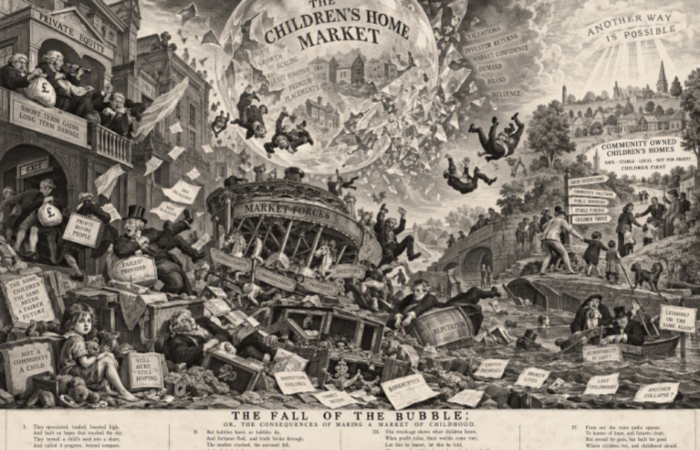
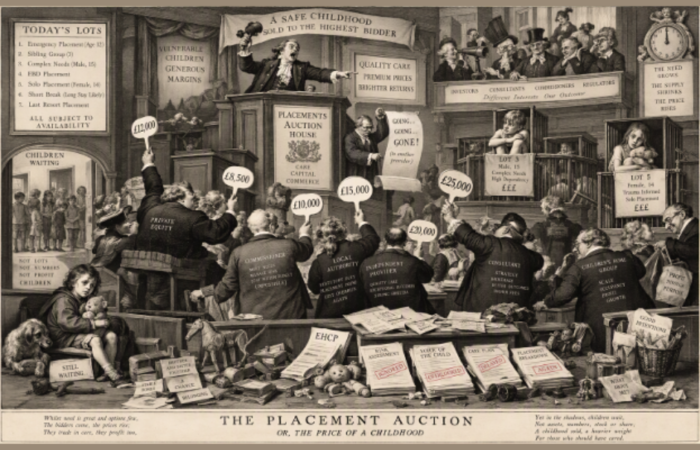
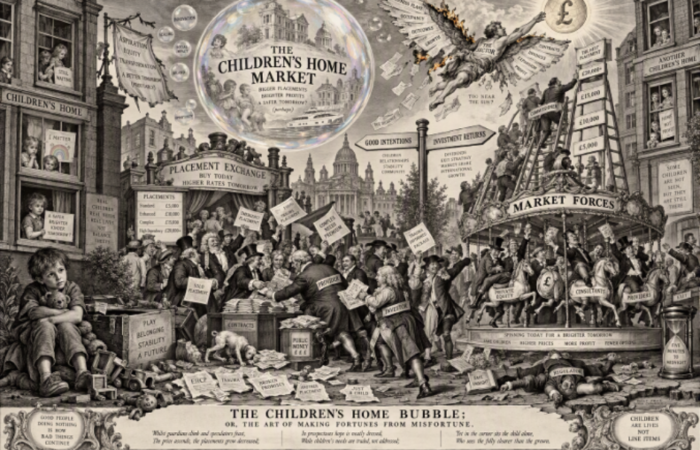
This is the fourth of four ‘Hogarth’ cartoons that depict a children’s homes market -…
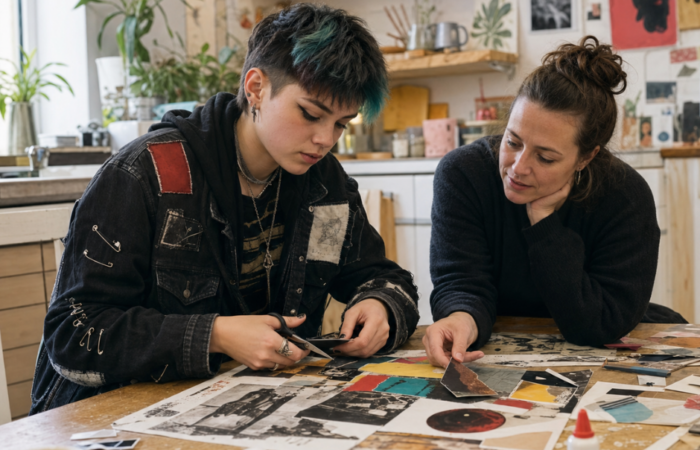
Punk Residential Child Care: Reclaiming Practice, Power, and Possibility
This blog is not about the music or the fashion, it is about the philosophy and the practice.
(Punk music is 50 years old this year. 8,000 tickets were sold recently for a punk festival with the oldest participant 82 and the youngest low teens. Punk lives!)
What’s this blog about? Punk philosophy gives residential child care a radical, usable framework for breaking out of bureaucratic stagnation, challenging dominant narratives, and reclaiming the creativity, dissent, and everyday meaning-making that frontline workers and young people generate. Applied properly, it becomes a method for democratising care, amplifying lived experience, and resisting the managerial logics that flatten the sector.
Introduction – the premise
Residential child care is a field saturated with regulation, surveillance, and moral scrutiny. It is also a field full of creativity, improvisation, solidarity, and everyday acts of resistance, qualities that rarely make it into policy documents or inspection frameworks.
As NCERCC re-read Dave Beer’s article Punk Sociology (Punk Sociology. David Beer. Palgrave Pivot. Jan 20140 we realised the ideas offered a way to surface these hidden energies and reorient the residential child care sector around the people who actually live and work within it.
Beer’s argument is not that sociology should become “punk” in aesthetic terms, but that it should adopt punk’s ethos: DIY creativity, refusal of orthodoxy, attention to the margins, and a commitment to unsettling comfortable narratives.
Residential Child Care in England desperately needs this.
Punk Residential Child Care can reshape the sector—conceptually, practically, and politically.
Gabba Gabba Hey – Be more punk!
Punk Sociology’s Core Principles and Why They Matter for Residential Child Care
Beer’s Punk Sociology rests on several key ideas:
- Disruption of dominant narratives
- Attention to the overlooked, the ordinary, the marginal
- DIY creativity and methodological experimentation
- A refusal to be constrained by institutional expectations
- A commitment to amplifying voices that are usually ignored
The riffs (a simple tune used as a pattern for creating more complicated musical patterns)
“Solos come and go, riffs last forever”. Keith Richards Rolling Stones
1.Residential child care is a perfect site for this approach because:
- The dominant narratives about children’s homes are, currently, overwhelmingly negative – risk, failure, danger, cost.
- The everyday life of homes is rarely documented with nuance.
- Workers’ knowledge is undervalued compared to managerial or regulatory knowledge.
- Young people’s voices are often instrumentalised rather than genuinely centred.
- The sector is governed by rigid frameworks that discourage experimentation.
Punk Sociology gives us permission—intellectual and political—to challenge this.
- Disrupting Dominant Narratives: Rewriting What Residential Child Care Is
Beer argues that sociology must confront and destabilise the stories society tells about itself.
Residential child care is burdened by stories told about it rather than from within it. These stories are often moralising, sensationalist, or reductionist.
A punk residential child care approach would:
- Expose how these narratives are constructed—by media, politics, inspection regimes, and market logics.
- Highlight the mismatch between public perception and lived reality.
- Reclaim narrative authority for young people and workers.
This is not simply a communications strategy; it is a professional and political act.
When the sector is defined by others, it becomes governable in ways that harm young people – through over-regulation, punitive oversight, and market-driven placement decisions. A punk residential child care will insist that we interrogate who benefits from these narratives and who is silenced by them.
In practice, this means:
- Documenting everyday life in homes with ethnographic richness.
- Publishing counter-narratives that foreground joy, creativity, and relational practice.
- Challenging the assumption that residential child care is inherently inferior to foster care.
- Exposing how “risk” is socially constructed and unevenly applied.
This narrative disruption is foundational for any movement seeking to democratise care.
- Attention to the Margins: Seeing What the System Doesn’t Want to See
Beer emphasises sociology’s responsibility to look where others don’t. Residential child care is full of marginalised spaces:
- The informal conversations between staff and young people.
- The micro-rituals of daily life—shared meals, bedtime routines, inside jokes.
- The emotional labour workers perform that is invisible in audits.
- The survival strategies young people develop in response to trauma and instability.
- The creative ways homes adapt to bureaucratic constraints.
These are rarely captured in policy or research because they are messy, relational, and resistant to quantification. A punk residential child care insists that these spaces are not peripheral—they are the heart of the work.
By foregrounding the margins, we can:
- Revalue the relational expertise of workers.
- Recognise young people’s agency and cultural production.
- Challenge the dominance of managerial metrics.
- Build practice frameworks that reflect real life rather than idealised models.
This aligns directly with child-centred care—but with a sharper ‘personal as political’ edge.
- DIY Creativity: Reclaiming Practice from Managerialism
One of Beer’s most compelling arguments is that sociology should embrace DIY creativity—making things, experimenting, refusing to wait for permission.
Residential child care workers already do this constantly, but the system rarely acknowledges it.
Examples include:
- Inventing new routines that help young people feel safe.
- Creating personalised rituals that build belonging.
- Developing informal mentoring relationships.
- Rewriting house rules to be more child-centred.
- Using humour, music, gaming, or art to connect.
- Building homes as micro-communities.
These acts are punk: improvised, relational, and often in tension with bureaucratic expectations.
A punk sociological approach would:
- Validate this creativity as legitimate professional practice.
- Encourage homes to develop their own cultures rather than conform to established models.
- Resist, by reinterpreting, the standardisation imposed by inspection frameworks.
- Promote worker-led innovation rather than top-down reform.
DIY creativity becomes collective creativity, grounded in democratic control rather than managerial oversight.
- Refusing Orthodoxy: Challenging the Logics That Govern the Sector
Beer argues that Punk Sociology must resist orthodoxy—especially when orthodoxy is comfortable, institutionalised, or taken for granted. Residential child care is governed by several powerful orthodoxies:
- Risk aversion as the primary organising principle.
- Market logic determining placements and provision.
- Inspection frameworks shaping practice more than young people’s needs.
- Individualised behaviour management rather than collective care.
- Professional hierarchies that devalue frontline workers.
A punk approach would interrogate each of these:
Risk Aversion
Just as with Punk Sociology so a punk residential child care exposes how risk is used to justify control, surveillance, and restriction. It asks: Whose risk is being managed? Who defines it? Who pays the price?
Market Logic
Punk residential child care challenges the idea that children’s homes should operate as commodities within a marketplace. It foregrounds the political economy of care and the exploitation embedded within it.
Inspection Regimes
It questions why inspectors hold more epistemic authority than workers or young people. Punk residential child care would push for democratic accountability rather than bureaucratic oversight.
Behaviour Management
It rejects the pathologising of young people and instead highlights the social, relational, and structural conditions shaping behaviour.
Professional Hierarchies
It insists that the knowledge produced by frontline workers is a rich and politically important are area of experience, practice, and theory.
This refusal of orthodoxy is not nihilistic—it is constructive. It clears space for alternative models, including cooperative, worker-led, and community-owned homes.
- Amplifying Silenced Voices: Young People as Cultural Producers
Beer emphasises that Punk Sociology must amplify voices that are usually ignored. In residential child care, young people’s voices are often:
- Extracted through consultation exercises (not participation).
- Sanitised for reports.
- Used to legitimise decisions already made.
- Framed through deficit narratives.
A punk approach treats young people not as data points but as cultural producers—creators of meaning, identity, and social worlds.
This means:
- Documenting young people’s cultural practices—music, fashion, slang, digital life.
- Recognising and reframing resistance, as hope, as a form of agency, not pathology.
- Valuing young people’s critiques of the system as insights.
- Co-producing research, policy, and practice frameworks with them.
- Treating their everyday creativity as central to the home’s culture.
This aligns with a punk residential child care’s commitment to democratic control: young people are not passive recipients of care but active shapers of it.
- Punk as a Framework for Cooperative Residential Care
Residential Child Care is in many ways, always has been, a punk project:
- It challenges the marketisation of care.
- It centres worker and community ownership.
- It disrupts dominant narratives about what care can be.
- It values everyday relational practice.
- It amplifies marginalised voices.
- It encourages DIY creativity in service design.
- It refuses managerial orthodoxy.
A punk residential child care ethos and commitment legitimises dissent, creativity, and experimentation. It frames cooperative care not as an alternative model but as a professional necessity.
- A Future for Punk Residential Child Care
When embracing Punk Residential Child Care we would see:
- Homes defined by culture, not compliance.
- Workers recognised as creative practitioners, not risk managers.
- Young people treated as co-authors of their care experience.
- Inspection frameworks replaced with democratic accountability.
- Market logic dismantled in favour of community ownership.
- Research that foregrounds everyday life rather than abstract metrics.
- Policy shaped by lived experience rather than managerial ideology.
- A sector that is proud, confident, and politically assertive.
This is not utopian. It is already happening in pockets. Punk residential child care gives the language, legitimacy, and conceptual clarity to scale it.
Conclusion
Applying the punk ethos to residential knowledge and practice gives people involved in its imagining something to think about, react to, kick against, or perhaps even to work with.
Related Posts