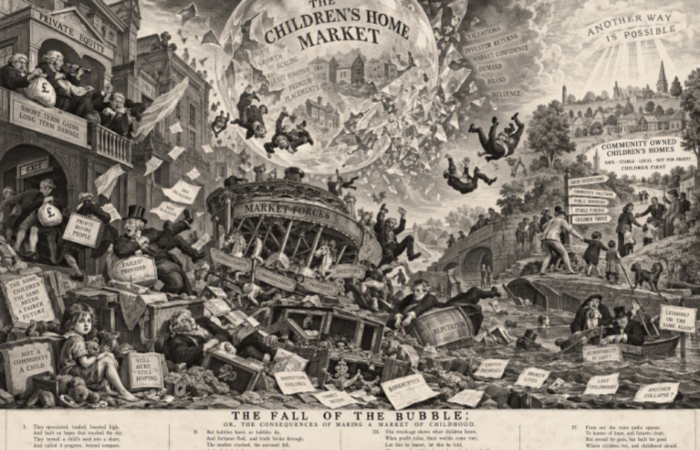
This is the fourth of four ‘Hogarth’ cartoons that depict a children’s homes market -…

Government Child Poverty Strategy weak on the causes of care
Better knowledge about how poverty and abuse and neglect affect children of different ages, backgrounds, and particularly children with disabilities is vital. Prof Paul Bywaters
The Government’s Child Poverty Strategy here does not explicitly make reference to important reports linking effects of child poverty preceding entry to the care system only the adverse outcomes of children who have been in public care.
It provides evidence, statistics and analysis informing its development and ongoing delivery, monitoring and evaluation along with action the Starmer government had already taken, and details measures to increase incomes, reduce essential costs and strengthen local services.
The need to address poverty was made to the Care Review. It is important to link that Josh Macallister went to the Cabinet Office after the review and was there with Pat McFadden, one of the authors of the published strategy.
Josh MacAlister in his Case for Change maintained poverty could no longer be treated as the “wallpaper of practice”. He said: “We have now reached a point where the weight of evidence showing a relationship between poverty, child abuse and neglect and state intervention in family life is strong enough to warrant widespread acceptance.” He cited a previous 2016 study by Prof Bywaters highlighting the link.
An example of the evidence to be included.
Professor Paul Bywaters reviewed 90 papers from 15 countries evidencing the link between poverty and abuse and neglect. He found consistency of evidence was compelling and highlighted a need for social care policies that addressed the economic circumstances of families. ( see The relationship between poverty and child abuse and neglect: new evidence). Changes in income alone, holding all other factors constant, have a major impact on the numbers of children being harmed. Reductions in income and other economic shocks increase the numbers being subject to neglect and abuse, while improvements in income reduce those figures.
Prof Bywaters said discussions about abuse and neglect shouldn’t be dominated by a focus on “what parents do and don’t do” but also the services and infrastructure framework for family life provided by government ” the socio-economic competence of family life is crucial for children’s social care to be effective”.
Prof Bywaters previously observed that it was “striking” that the government’s Working Together to Safeguard Children document “doesn’t mention family poverty, income or employment once”.
“There is a need for government to ensure that all families have the basic conditions to bring up their children successfully. Families also require a better response from local government and local practitioners to the poverty that they are experiencing.”
He pointed to the need for more detailed and nuanced information about how the relationship between poverty and abuse and neglect works, particularly how it affects different children differently.
Research led by Prof Bywaters for the Child Welfare Inequality project has shown children in the poorest neighbourhoods are ten times more likely to be taken into care or placed on a child protection plan than those in the most affluent areas.
“The international evidence about the relationship between poverty and child abuse and neglect is much stronger now than it was five years ago,” said Professor Bywaters.
“From this research, we can be certain that increased pressures on family life will lead to the risk that more children will be subject to harm, abuse and neglect, unless government and service providers can respond more effectively.
Prof Bywaters has commented that poverty is too often seeing by services and by workers as a as a background issue as structural as distant. It does not reflect the meaning of poverty for people who are living with it, which is something that’s evasive, constant and an immediate worry, brings anxiety and depression, family conflicts, sleep disorders, lack of energy and vitality and hopelessness.
“It means too often parents feel that some of their most pressing difficulties they need in their children’s needs are not recognised. And this feels like a lack of respect, which adds to feelings of stigma and shame.”
NCERCC VIEW
The new Burnham government needs a focus on understanding what it really feels like to live in poverty and therefore how to intervene effectively and bring the impact of poverty into that wider planning and approach to how we support and intervene with families.
Children’s social care approach is reactive, see Family Hubs or Breakfast Clubs, rather than for investment in a rich nurturing environment.
Related Posts