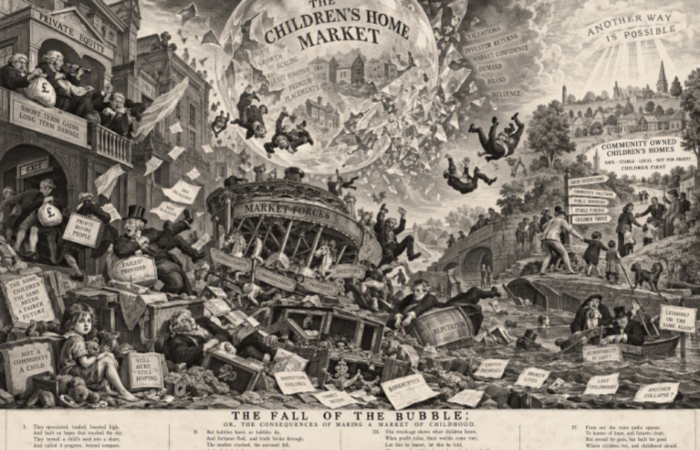
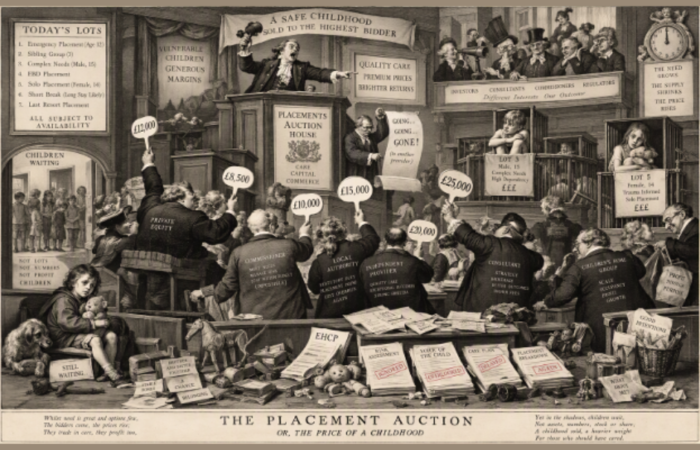
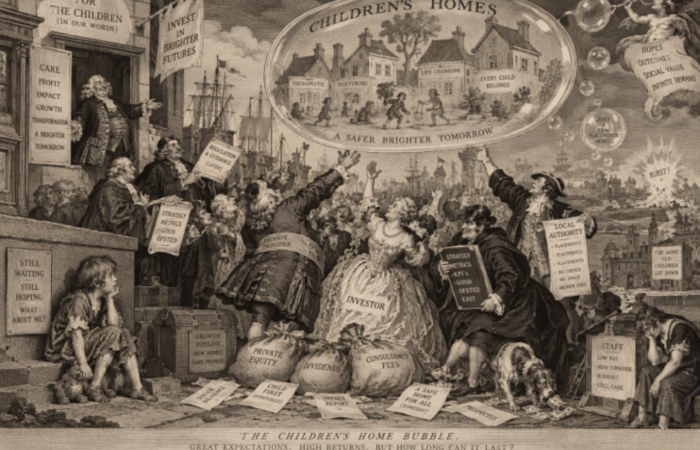
This is the fourth of four ‘Hogarth’ cartoons that depict a children’s homes market -…
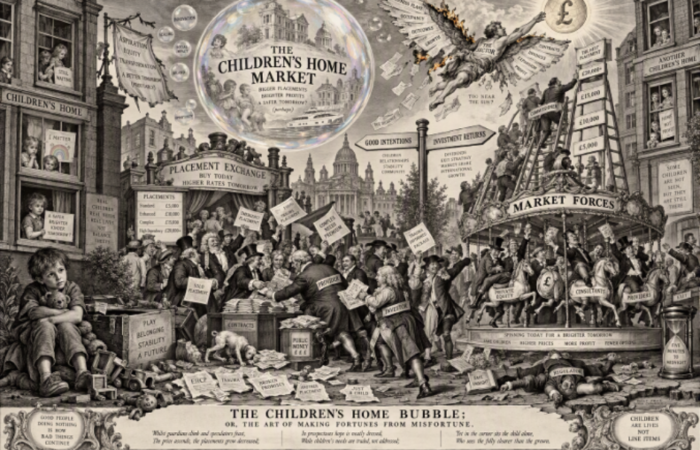
Hogarth – children’s homes bubble: the art of making a fortune from misfortune (2 of 4)
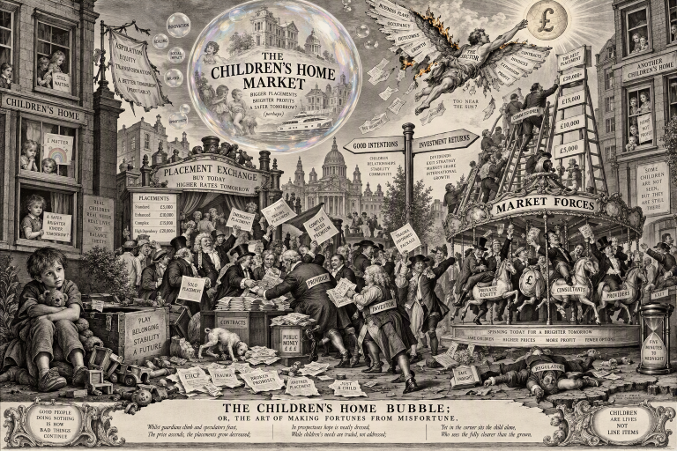
This is the second of four ‘Hogarth’ cartoons that depict a children’s homes market – rise, excess, crisis, and renewal.
In this one we pushed the Hogarth composition further to become less an illustration and more an allegory where every corner contains a critique of the marketisation of care.
The focus here is on excess.
Overall Composition
The scene resembles an eighteenth-century London marketplace descending into speculative madness, except the commodity being traded is residential child care.
At the centre of the image hangs an enormous iridescent soap bubble inscribed:
“THE CHILDREN’S HOME MARKET”
The bubble dominates the sky like a false moon, reflecting gold coins, mansions, and balance sheets. Hairline cracks are beginning to form across its surface, hinting at an imminent collapse.
Foreground Left: The Child Witness
In the bottom left corner sits a single child, not distressed or theatrical, but thoughtful.
The child is seated beside a battered toy box, holding a small teddy bear with one arm repaired by stitching. Around them lie broken toys, fragments of care plans and EHCP documents being trampled.
The child looks directly at the viewer while gesturing toward the chaos.
This is the moral centre of the print.
‘Hogarth’ presents the critique that unlike every adult present, the child understands what is happening.
Centre: Trading in Placements
Below the bubble stands a makeshift stock exchange with commissioners and providers frantically trade certificates labelled:
- “Emergency Placement”
- “Solo Placement”
- “Complex Needs Premium”
- “High Dependency Package”
The documents are treated as was stock in the South Sea bubble.
Contracts change hands, money spills from pockets, ledgers are feverishly updated.
Nobody appears concerned with children.
Right: The Market Forces Merry-Go-Round
A carousel dominates one side of the scene. The sign above reads:
“MARKET FORCES”
Private-equity figures, consultants and executives ride painted horses made from pound signs and spreadsheets.
The carousel spins ever faster.
Several riders are showering themselves with money.
One executive waves a prospectus.
Another is trying desperately to stay mounted as the machinery strains and begins to crack.
Hogarth loved showing impending disaster hidden inside apparent celebration.
Upper Right: Commissioners Climbing
A series of commissioners climb increasingly absurd ladders reaching into the sky.
At the top of each ladder hangs a tiny placement contract.
Every higher rung displays a larger price:
- £5,000
- £10,000
- £15,000
- £20,000+
As they climb, bags of public money tumble from their pockets.
One ladder is visibly breaking beneath the weight.
Background Windows
Children peer quietly from the windows of the children’s homes surrounding the square.
Some are watching.
Others hold drawings pressed against the glass.
One waves while adults below fail to notice.
Hogarth used emotional inversion repeatedly: those affected have the least power, while those with power fail to see them.
The Signpost
Near the centre stands a weathered signpost.
One arrow reads:
“GOOD INTENTIONS”
The arrow points toward a small, neglected path partly hidden by weeds.
Another larger, glittering sign points toward:
“INVESTMENT RETURNS”
A crowd rushes in that direction.
Nobody follows the first sign.
The Icarus Figure
High above the scene flies a winged figure representing the sector.
His wings are made from:
- contracts
- invoices
- occupancy reports
- business plans
The sun bears the face of a golden coin.
As he climbs, the paper wings begin to burn.
Contracts flutter from the sky like feathers.
A few observers look upward in alarm.
Most continue gambling.
Additional Hogarthian Details
Scattered throughout the engraving:
- A fox dressed as a gentleman counting money beside a henhouse labelled “Care”.
- A jester balancing on account books while carrying a child-sized key.
- A merchant stuffing placement contracts into a treasure chest.
- A blindfolded crowd cheering the bubble’s growth.
- A clock showing five minutes to midnight.
- A cracked foundation beneath the entire marketplace.
It is to be noted:
- The child is the only genuinely rational observer.
- The bubble communicates fragility rather than simple greed.
- The marketplace of placements turns a familiar procurement process into something visibly absurd.
- The Market Forces carousel captures the sense of a system that must keep spinning faster to sustain itself.
- The Icarus figure introduces the idea that even beneficiaries of the system may be heading towards collapse.
- The neglected signpost to Good Intentions reminds viewers that most people entered the sector for the right reasons.
Related Posts