...accepting we, still, don’t know as much as we think we do accept that we,…

Thinking towards the active de-extinction of Therapeutic Child Care
Has Therapeutic Child Care ( TCC) become extinct? When did it happen? How did it happen?
Is it possible to revive something that has become extinct? If the answer is No
Then, what is it that calls itself TCC today?
Premise
What is being called Therapeutic Child Care today differs markedly in the provision of that which has been seen as TCC over decades and for which there are defining features.
Place
The pioneering origins of TCC can be traced. Are there any settings in England that work to a large group model such as at the Cotswold Community or PeperHarow, or similar others (readers – enter names here ….)?
The era of large group TCC has ended. For various reasons there is a preference for small groups. A notable factor is the loss of the ability to conduct group dynamics/groupwork, to work with a group. That is a strong factor in the move to smaller and smaller settings, psychosocial therapeutic understanding and therefore management has ceded to individualism reasons cited as safeguarding in various forms.
There are settings that provide for a bigger groups that come together regularly but mostly are within smaller group, maybe on the same campus, more often separated but close by.
Principles
There are very few settings that provide a continuity, and development, of knowledge and practice to the guiding principles and methods of the pioneers.
A few have a link to these through a person or personnel, and have established a practice methodology and ethics the culture, the know-how, how to do it, which has been passed along through an education and role modelling method.
There are the TCC Standards that provide a practical guide to TCC practice. There are few how adhere to these standards, if they are known.
It would be useful to explore the reasons people do not adhere to the standards. Here’s some surmised responses – not got the knowhow organisationally or personally; it is intensive and therefore expensive in eyes of LAs who want a slimmer cheaper version; we don’t see therapeutic in the same way as TCC standards as we are not a community we are a setting/environment/resource; we didn’t know what TCC meant, we saw others using the term and followed; Placement Request Forms said they were looking for a ‘therapeutic’ placement and it said the child needed therapy so we engaged a therapist; being trauma informed is therapeutic.
It is in these latter responses we begin to see the issue.
When does extinction occur? When the originals die out? Or when they become hybridised to the point they have little similarity to the origin?
This begs a question, given that the large group is gone (but interestingly not in all countries though the settings may be few), is it possible to revive something that is extinct? Are there good reasons to try? How?
There clearly is an attraction to the name though if what is being practised as TCC actually is maybe another matter.
From the list there are clearly settings using the name that constituently are not the same. Are they TCC? When does TCC not become TCC through diversion or dilution? When does adding something to the TCCness make it not so.
That these questions can be asked is an indicator that the boundary of the definition of TCC has become unclear. This has happened by neglect, by lack of challenge, by lack of definition that could cohere practice.
Does it matter? Yes it does. In collapsing many things into one catch all title of ‘therapeutic’ we are not able to see important things, like matching. The same thing has happened with the development of the term ‘complex’ that when challenged with the concept of ‘co-occurring’ the lack of rigour becomes apparent.
Clearly there are many differences between settings using the name therapeutic. They are not the same, sometimes in major ways.
TCC might be said to be an approach rather than anything more formal, though the standards are demanding there are infinite ways of achieving them.
It can be said that with few exceptions those using the term are not faithful to the term as used originally or in the standards as they differ constituently.
So could the exceptions be used to grow a new TCC? Accepting it would not be a faithful recreation; but it might be a close replica? That might assist in conserving (different to preserving as a conserving requires activity) TCC.
This is not an easy task as the DNA of TCC has been fragmented even broken.
In biology it has been concluded that we should try to recreate a lost species only when there is a conservation benefit, such as restoring an eco-system in which the animal played a key role.
It is on this basis that I would propose a restoration of the term and practice of TCC. That many ‘do not know what to do with this child’ and the drive towards solo, 2:1/3:1 settings; DOLS; pop ups; unregulated; suggests to me that the way of understanding their actions needs revision. There is always something that can be done. Reframing from ‘don’t know let’s use numbers of staff’ to ‘let’s be curious’ might get us somewhere closer to the child. Yes other approaches use the same word of curiosity eg PACE, but not in the same way as TCC.
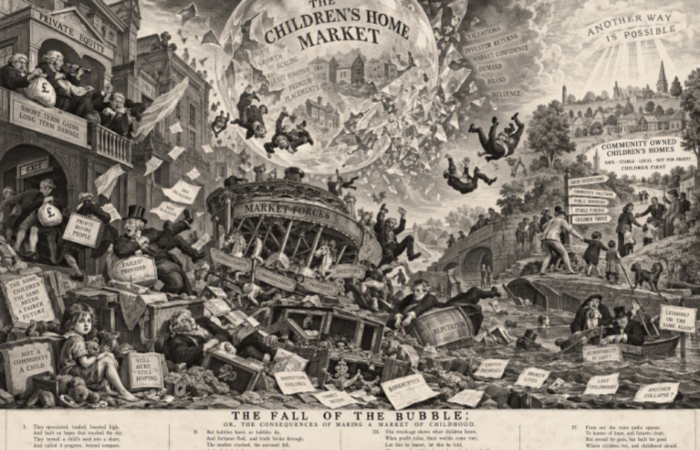
The current circumstance is that we have settled for replacement of TCC rather than a resurgence. We looked for innovation when innovation was always there and present. TCC was not disseminated and has been supplanted by approaches that seek the allure of TCC but without the rigour. In allowing them to utilise the term TCC we have enabled a proxy-TCC to be established that both wipes out the correct use and actively territorialises the ground of TCC.
We need to Revive and Restore TCC.
Just as with children the return to the usual psycho-social development takes time so will it with TCC.
The term TCC must be liberated from its current opacity. It needs to be a protected title. The TCC Standards set out what is required for the use of the term.
If settings wish to use the term about their practice they must either be adhering to the Standards or have a plan for developing their thinking and practice to be able to adhere.
The planning gap analysis will likely show some common aspects so we can start with some concepts and activities to be undertaken by settings. Having practice development provided and support will be cost effective. It is likely that this can be provided by those with a link to TCC origins and adherence to the Standards, very probably they will have workforce development and consultancy established as a means of continuing their culture and practice. These settings should be termed ‘Working towards TCC.’
Others may decide they do not want to be seen as TCC. However they may want to use some aspects. These we should term ‘hybrid TCC’.
It is highly probable that an outcome of this activity is the finding that we don’t need TCC as was provided by the pioneers though we do need a structure to assist consistency of understanding.
It is highly likely that we will find a definition of TCC that fits to the current circumstance.
TCC is always adapting. It is always in development. There is always a struggle to define the therapeutic space. This moment is no different for TCC than it ever has been.
One aspect of the change will be that we open our minds to the needs of children, that we adopt a greater intersectionality than ever. TCC has always been intersectional. However one of the consequences of the diversion and dilution has been that the focus for each of the settings calling themselves ‘therapeutic’ is that the focus for each has become reduced and there is an active reduction in conceiving of needs, itself a reaction to rigid regulation of risk. We need to open up our thinking as to the reality of co-occurring needs, the numbers are more and needs are higher than we can currently imagine safely. This will require appropriate funding for TCC for higher needs, not to reduce their formulation to a level that can be safely considered. It is going to take more money. It is going to require a workforce development such as we have not seen ever.
In making the above point it is clear that if we do not follow this path we will find ourselves out of our depth, an interesting phrase but accurate as swept by unrelenting merciless strong currents with children finding no haven.
TCC is demanding , time consuming, intensive, more expensive than other lesser forms. However it is less expensive than integration where time/energy is spent on the aggregation.
De-extinction is more effective for children and more efficient for spending.
Related Posts