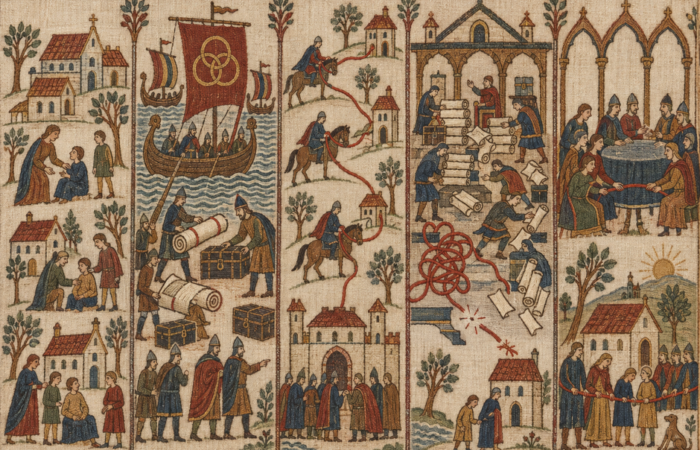
The Bayeux tapestry exhibition has just opened and is attracting a lot of interest. It…

Why Residential Child Care Cannot Be a “Pick and Mix”
Why Residential Child Care Cannot Be a “Pick and Mix”
Residential child care cannot operate like an old time high street shop’s, some will remember the name, “pick and mix” counter, where a selection of sweets could be chosen, bagged, then weighed.
A successful home requires a deeply integrated ecosystem, not a casual selection of disconnected features.
When a provider treats culture, care models, and purpose as standalone options to grab off a shelf, the entire system is always in danger of collapse. It might not now, or tomorrow, but the potential is always present. People with experience will tell you such things have a way of working themselves out in residential settings.
To understand why this approach fails vulnerable young people, we must examine the essential foundation factors that require total cohesion.
The Flaw of the “Pick and Mix” Approach
The classic ‘pick and mix’ allowed shoppers to throw random, unrelated sweets into a single bag. It did not matter if a sour fried egg touched a sweet foam strawberry; they remained distinct entities.
In residential child care, you cannot combine unrelated elements without creating chaos.
- Incompatibility:
A therapeutic or trauma-informed philosophy (the two are different, see the NCERCC blog distinguishing) cannot coexist with a compliance seeking behaviour management system (yhough a treatment oriented might). - Confusion: Staff members cannot pivot between conflicting ideologies within themselves, within the shift, and shifts. Splits in any team are to be avoided, but these are possible where elements of philosophy and practice are not in harmony. It is like there are potholes in the road that sooner or later will get you
- Instability: Children who have experienced trauma require absolute predictability, not a patchwork environment. They need a secure base (see https://www.uea.ac.uk/groups-and-centres/centre-for-research-on-children-and-families/secure-base-model) with everythung attuned and optimal
1. Culture: The Living EnvironmentCulture is the invisible glue of a residential home. It is not just what management says they do; it is what staff and children actually feel and experience every day.
- Relational Safety: True therapeutic culture is grown over time through authentic, safe human relationships.
- The Living Environment: Culture lives in the smell of home-cooked food, the shared laughter, and how conflict is resolved.
- Organic Growth: You cannot buy a positive culture or select it from a manual. It emerges naturally when needs, purpose and care models align perfectly.
2. Clarity of Purpose: Defining the Primary task
Clarity of purpose is another of the foundations of the home. It dictates exactly who the home is for and what it aims to achieve, and how. It is not a generic statement on a website.
- Targeted Care: A home must know if its purpose is short-term crisis stabilisation, long-term therapeutic care, or preparation for independent living. A home needs to know it cannot, must not, do everything.
- Operational Alignment: The purpose dictates the needs, the care, tge physical layout, the geographic location, and the daily routines. It matters how you do what you do
- Matching Referrals: Without strict clarity, homes accept referrals based on empty beds rather than suitability. This leads to destabilisation and placement breakdowns.
3. Model of Care: The Clinical Framework
The model of care is the evidence-based framework that guides how staff interact with children. It provides the “why” behind every response.
- Theoretical Unity: whatever the model, it is crucial, named and deep in theory, to have a model, it must be applied universally.
- Consistent Responses: Children must know that every staff member will respond to their distress in the same therapeutic manner.
- Staff Confidence: A single, clear model gives staff a shared vocabulary and a unified toolkit during a crisis.
The Danger of Fragmentation
When these three factors are treated as independent choices, the home becomes fragmented.
A home does not offer ‘packages of care’.
There is no short cut to being therapeutic. Becoming therapeutic does not come by there being therapists for children. A therapeutic home has knowledgeable people with experience and expertise gained over years. There is no short cut. A home starts getting to understand how what they do is therapeutic after about 7 years. In such homes some children may need therapy too, for identified reasons, but many will be getting enough from the ‘therapeutic milieu’ created all day everyday.
A home might choose from a book or presentation, or buy a ‘highly rated’ model of care from a brochure or consultant, but if it does not have the above it is a set of buzzwords The children ‘know’ it, and they tell us by what they do, behaviour is communication. Challenging behaviour is children communicating the challenging environment they have been placed in.
Similarly, if the Clarity of Purpose is compromised to fill beds, the therapeutic culture is instantly shattered by matching incompatible needs.
Vulnerable children do not need a random assortment of care strategies. They need a single, solid, unbreakable foundation where purpose, model, and culture are woven into a seamless safety net.
Related Posts