...accepting we, still, don’t know as much as we think we do accept that we,…

A critical guide to private equity, social capital, social finance in children’s social care
Social finance aims to achieve measurable social or environmental outcomes alongside financial returns, distinguishing it from pure philanthropy or conventional investing
…“hard nosed economic feel while restating the importance of the social”. (Halpern, 2005, Social Capital, Polity Press)
“Investment in social relations with expected returns in the marketplace.” (Nal Lin, Social Capital: A Theory of Social Structure and Action. Cambridge: Cambridge University Press)
Unlike philanthropy, which has a similar mission-motive, social finance secures its own sustainability by being profitable for investors. Capital providers lend to social enterprises, who in turn, by investing borrowed funds in socially beneficial initiatives, deliver investors measurable social returns in addition to traditional financial returns on their investment.
Private equity
Private equity is typically accessible to institutional investors, high-net-worth individuals, and specialised funds. Investors provide capital, expertise, and strategic guidance to help companies grow and maximize returns.
Private equity is a form of capital investment aiming for value creation through active management, long-term commitment, and strategic interventions, offering the potential for high returns but with higher risk and lower liquidity compared to public markets
Social capital
Often depicted as finance with a sense of social purpose with values of co-operation and reciprocity, portrayed as creating public goods for a common purpose.
It aligns with investments seeking a project where it more likely to get a return than funding own provision, or to join with others in diversified investment. Though there can be socially oriented objectives this does not have to be the priority and it can be a commercial decision, a rational choice. It can be a cost-effective method of investment without reflecting on the worthiness of that goal.
Halpern (Halpern, David, 2005, Social Capital, Polity Press), a developer of the Behavioural Insights Team, argues that the popularity of social capital for policymakers is linked to the concept’s duality, coming because “it has a hard nosed economic feel while restating the importance of the social.”
Halpern also developed the idea of the ‘Catherine Wheel’. The Catherine Wheel consists of macro-level factors which create “a stable pattern of collective investment in public goods, such as education and the welfare state, that attenuate economic and social status differentials, and that in turn create an environment that stimulate social trust, community and associational life”(p. 276). At the heart or “axle, of the wheel stand the society’s common social values, such as mutual respect, trust and consideration of others”(p. 276). He also outlines the process, “rather like a rope made of thousands of tiny causal threads entwined together into broader cords, which are then in turn bound together to form the rope itself” (p279)
Halpern gives several reasons why social capital is not an aspect of human life that governments should ignore. He believes that ‘market failure’ arguments apply because social capital, as a quasi-public good, is vulnerable to systematic under-investment by rational individual actors. Second, ‘equity’ arguments are thought to apply, since unequal access to social capital will be exacerbated without government intervention. Third, he argues that “even if social capital once looked after itself, changing social and economic conditions may have undermined this delicate equilibrium” (p. 286). Finally, he argues that intervention is a good idea because it has been shown to work in the past, even if it was not for the expressed purpose of effecting social capital.
Nan Lin‘s concept of social capital is of “Investment in social relations with expected returns in the marketplace.”
Robison and colleagues (2012) measured the relative importance of selfishness and four social capital motives. The selfishness motive assumes that an agent’s allocation of a scarce resource is independent of his relationships with others.
Social capital motives assume that agents’ allocation of a scarce resource may be influenced by their social capital or sympathetic relationships with others which may produce socio-emotional goods that satisfy socio-emotional needs for validation and belonging:
- The first social capital motive seeks for validation by acting consistently with the values of one’s ideal self.
- The second social capital motive seeks to be validated by others by winning their approval.
- The third social capital motive seeks to belong. Recognizing that one may not be able to influence the sympathy of others, persons seeking to belong may act to increase their own sympathy for others and the organizations or institutions they represent.
- The fourth social capital motive recognizes that our sympathy or social capital for another person will motivate us to act in their interest. In doing so we satisfy our own needs for validation and belonging. Empirical results reject the hypothesis often implied in economics that we are 95% selfish.
Social Finance
Social finance serves as a bridge between traditional business, which primarily seeks financial profit, and philanthropy, which primarily seeks social benefit, by intentionally combining both objectives. It involves deploying capital to support projects, initiatives, or enterprises that address social challenges—such as education, healthcare, environmental sustainability, and community development—while also providing investors with financial returns
Social finance aims to achieve measurable social or environmental outcomes alongside financial returns, distinguishing it from pure philanthropy or conventional investing
Participants include charitable foundations, institutional investors, and retail investors who are interested in aligning their capital with social and environmental values
Social finance is a category of financial services that aims to leverage private capital to address challenges in areas of social and environmental need. It is an approach to solving social problems while simultaneously creating economic value.
Unlike philanthropy, which has a similar mission-motive, social finance secures its own sustainability by being profitable for investors. Capital providers lend to social enterprises, who in turn, by investing borrowed funds in socially beneficial initiatives, deliver investors measurable social returns in addition to traditional financial returns on their investment.
Investors include charitable foundations, retail investors, and institutional investors
The social finance ecosystem is composed of four key groups:[11]
- Investors: Investors, or capital providers, serve as the initial and primary source of capital in social finance. Examples include retail investors, high-net-worth individuals, pension funds, charitable foundations, and private foundations.
- Social enterprises: Social enterprises represent the demand for investment in social finance. They absorb the capital invested by investors, reinvest this money in various socially beneficial initiatives, or social investments, and finally deliver investors twin social and financial returns on their investment. Examples include non-profit organisations /foundations.
- Social finance institutions: Social finance institutions act as financial intermediaries by linking the supply and demand of capital. They are responsible for raising funds from investors, pooling these funds, and redistributing them to social enterprises. Social enterprises are ranked by profitability, and preference is given to organizations with strong track records of effective social service.
- Intermediaries: Intermediaries facilitate and oversee the myriad connections between the first three groups. They include regulators, trade groups, and service providers.
It has been described as “patient capital” being funding with a longer-term repayment schedule.
Social finance is conceptually a very different approach to social welfare enhancement, however, in that, by combining the ideas of neoliberal markets (in creating a profit and financial return) with taking care of social needs (in the way that a charity would), social finance secures its own sustainability by being profitable for those who fund these organisations. It is funded by investors, who receive a return on their investment, rather than donors, who forgo their contribution at the time of donation. The ‘blended’ social and financial returns are a defining characteristic of social finance and distinguish it from related practices, such as not-for-profit investing, charity, and philanthropy
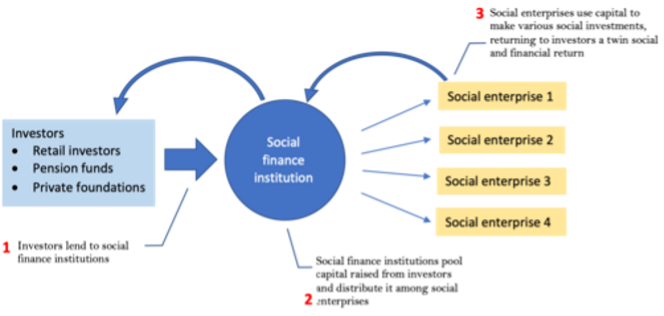
Capital flows in the social finance workplace
(Ferniebridgebritishcolumbia)
- Investors lend to social finance vehicles
Investment flows from retail investors, pension funds, charitable institutions
- Social finance institution bridges investors and investment
Pooled capital is distributed among social enterprises
Receives from investors and provide return on investment.
- Social enterprises receive investment and provide a return on investment
Related Posts