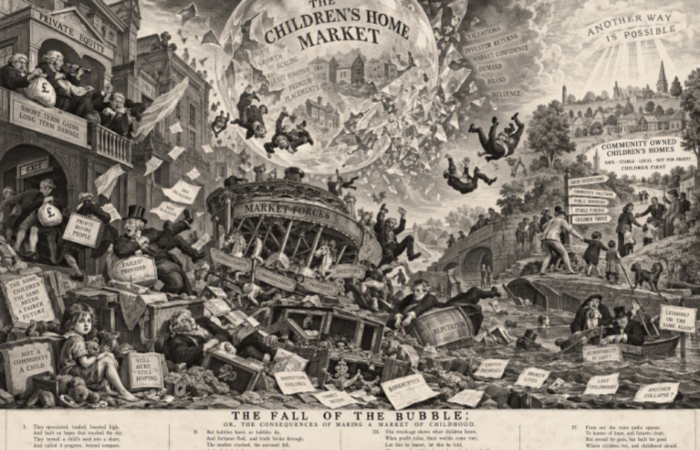
This is the fourth of four ‘Hogarth’ cartoons that depict a children’s homes market -…

Lived experiences being heard is real voices, real change and….
…accepting we, still, don’t know as much as we think we do accept that we, still, know little, or at least not as much as we think we do
Lived experience should shape the policies, services and decisions that affect lives.
One definition of lived experience[1] is “what someone has experienced themselves, especially when it gives the individual knowledge or understanding that people who have only heard or learnt about such experiences do not have”. This is wide enough to encompass research, practice, policy.
It establishes the foundational assumption of the lived experience perspective: that unique and important key aspects of needs and services are known or understood by people who have had or have these needs or receive/d these services.
The professional is not the only perspective. It separates the detached observer from the experiencing individual. Such detachment has often been assumed and presented as being ‘more objective’ and taken as more valid. In prioritising the professional above the personal the meaning and richness to the child is absented.
We assume that the theory and research apply universally. We assume we know a lot. A recent medical overview of knowledge about the workings of the brain concludes we, still, know very little. Even in claimed ‘evidenced’ practice we might accept to retain some modesty that we, still, lack solid theoretical foundations and we do not have systematic evaluation of epistemic and ethical impacts. This being the case we, still, have time and opportunity to include lived experience.
At this moment where research remits are often directed to developing policy-based evidence it can be said that such endeavours tell us ‘something’, insights, inferences, but with so many intervening variables it is not simple to discern definitively ‘what’ or ‘how’. Both the professional policy-based evidence and lived experience might be dismissed as irrelevant, or taken up only performatively, or deployed as a means to prevent or to motivate a politically sensitive project
Recently NCERCC has stopped asking about the model of care and taken to focus on the theory of change. Explain ‘change’ and ‘changes’, focus on the ‘how’ as a means to understand the ‘what’.
We must expect dilemmas, for example, in a child’s review when lived experience, the personal, engaging with the professional, the two perspectives conflict. How does lived experience contribute to the understanding and projecting of outcome? Whose voice is heard?
If we accept that we, still, know little, or at least not as much as we think we do (in order to do the job there are psychological defences), if we prioritise one view above the other is the full range of insights included? If we only taken the ‘easy’ way, perhaps siding with one view over another, what is being neglected? For there to be a pearl requires that there is irritable grit included in the system.
[1] World Health Organisation
Related Posts