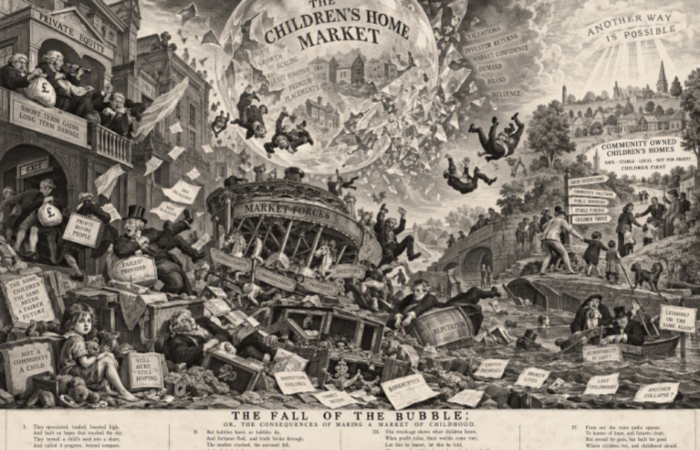
This is the fourth of four ‘Hogarth’ cartoons that depict a children’s homes market -…

A Burnham repurposing of Residential Child Care requires the relational reimagining of regional care cooperatives – and so much more
Shifting English Residential Child Care from a technocratic, market-driven procurement model to an ecosystem anchored in relational governance and community power, English residential child care development planning must undergo structural re-engineering.
While the Independent Review of Children’s Social Care proposed Regional Care Cooperatives to achieve better market scale, this blueprint redefines RCCs as democratic, multi-stakeholder social ecosystems.
This strategy synthesises the philosophies of James Purnell and Graeme Cooke’s “We Mean Power” and the UCL Policy Lab’s “Britain Renewed” to dismantle sector fragmentation and prioritise deep relational stability over financialised outsourcing.
Reimagining English Residential Child Care: A Blueprint for Relational Governance and Community Power
- Deconstructing the Status Quo: The Technocratic Market Failure
The contemporary landscape of English residential child care operates under a hyper-financialised, bureaucratic framework. Under Section 22G of the Children Act 1989, local authorities hold a statutory “sufficiency duty” to secure sufficient accommodation for looked-after children within their local area. However, market realities have rendered this duty nearly impossible to fulfil.
The Commodification Trap
Current commissioning relies on technocratic procurement frameworks, dynamic purchasing systems (DPS), and spot-purchasing from a highly consolidated marketplace. Large independent providers, frequently backed by private equity firms, leverage economies of scale to dominate the sector. This creates severe structural pathology:
- Forced Displacement: Vulnerable children are routinely placed at distanced from their home communities due to local scarcity affecting educational, therapeutic, and familial ties.
- Financial Outflows: Public capital is extracted as high profit margins and debt servicing rather than being reinvested into local care infrastructure.
- Risk-Averse Bureaucracy: The consequences of current interpretation of regulation affects the risk assessment that is applied and highlights deficit behaviours rather than individual children’s strengths, assets. In this way the system works against providing deep relational stability.
- Core Pillars of the Relational – Blueprint
To move beyond this extractive paradigm, development planning must blend the relational, democratic state proposed in Britain Renewed with the community organising, power-shifting mechanisms of We Mean Power.
| Traditional Market Paradigm | Relational & Community Paradigm |
| Spot-purchasing commodities | Local Place-Shaping & Assets |
| Standardised risk mitigation | Deep Relational Continuity |
| Extractive profit-taking | Non-profit, Local Wealth Building |
| Top-down administrative | Child centred |
Pillar I: Local Place-Shaping and Democratic Asset Building
Britain Renewed argues that public services must move away from remote, uniform delivery and root themselves in the unique socio-cultural fabric of local places.
In residential child care, this translates to an absolute rejection of the “any provider, anywhere” model.
- Hyper-Local Asset Mapping: Sufficiency must become Specificity. Care planning must transform from a quantitative forecasting exercise into a qualitative asset-mapping strategy. Local authorities must partner to design and embed small-scale (2-to-3-bed) children’s homes into ordinary residential neighbourhoods.
- Community Integration as Statutory: Homes should not be isolated enclaves. Development planning must actively co-locate residential provisions alongside community assets like youth hubs, family hubs, community orchards, and public sports facilities. The physical location must facilitate positive, non-stigmatising social interactions between looked-after children and their peer groups.
- Reinvesting Public Capital via Local Wealth Building: Following the “Preston Model” principles implicit in Britain Renewed, public capital for care must circulate locally. Capital developments should prioritise local resourcing ensuring that each home strengthens the local socio-economic fabric.
Pillar II: Reciprocal Agency and Co-Produced Networks
We Mean Power emphasises that genuine transformation occurs when institutions stop doing things to people or for people and start doing things with them.
In the context of residential care, this demands an overhaul of how children’s voices and community relationships shape day-to-day operations.
- From “Consultation” to Real Shared Power: Current planning frameworks use tokenistic feedback loops. Under a relational framework, young people in care must hold institutional power, shifting the environment from institutional to a collaborative household encompassing, for example, co-designing the home (the rules, the environment), involvement in recruitment.
- Reciprocal Care Ecosystems: Instead of looking at a child through a lens of vulnerability and deficit, each home must cultivate reciprocal agency. Children should be supported to contribute to their neighbourhoods through volunteering work, community arts, or mentoring programs. This reciprocity breaks down the destructive “provider vs. recipient” dynamic, building self-efficacy and restoring a sense of civic belonging.
- Active Family and Kinship Preservation: Working with the ‘family-in-mind’ relational governance sees a child’s family network not as something distinct and to be supervised (though for safeguarding it might need to be) but as part of an extended care network. Approaching each home as a planned environment with each room having a role and function there must be physical spaces within or adjacent to children’s homes where birth families, kinship carers, and lifelong advocates can stay, cook meals, and participate in daily life, assuming it is safe to do so.
Pillar III: Elevating the Workforce to Eliminate Sector Fragmentation
The high turnover and low pay characteristic of English residential child care are direct outfalls of technocratic cost-containment. A relational framework recognises that the care relationship is the primary therapeutic intervention, making workforce stabilisation the core of development planning.
- Parity of Esteem and Professionalisation: Residential child care practitioners must be elevated to a status equivalent to social workers, teachers, or clinical nurses. Specificity funding formulas must guarantee professional-grade salaries, fully funded therapeutic qualifications (such as systemic or psychodynamic practice), and transparent, long-term career pathways.
- De-bureaucratisation of caring: Relational care requires time. Current regulatory compliance frameworks demand exhaustive logging, for example of incidents. This is defensive documentation. Inspired by the relational principles of Britain Renewed, planning must transition to “high-trust, high-accountability” frameworks. Practitioners must be liberated from computer screens to spend their shifts cooking, talking, playing, and co-navigating with children.
- Eradicating Agency Reliance: The gig-economy model of agency staff utilisation shatters relational continuity and drives up costs. Development planning should invest in localised, permanent “resilience pools”—salaried, highly trained practitioners employed directly by local partnerships who can step into homes during staff shortages, maintaining a consistent therapeutic culture.
- Structural Re-engineering: Overcoming Sector Fragmentation
The biggest hurdle to implementing this vision is the deep fragmentation across local authorities, health services, education providers, and the independent sector. Britain Renewed and We Mean Power provide the institutional tools required to forge a unified, mission-driven alternative.
Regional Care Cooperatives (RCCs) Reimagined
While the Independent Review of Children’s Social Care proposed Regional Care Cooperatives to achieve better market scale, this blueprint redefines RCCs as democratic, multi-stakeholder social ecosystems.
- Rather than behaving like mega-procurement hubs that consolidate buying power, RCCs should operate as public-civic partnerships bringing together local authorities, Integrated Care Boards (ICBs), local schools, housing providers, and regional non-profits.
- They should operate on a strict not-for-profit model, legally binding all surplus revenues to be reinvested into frontline salaries, therapeutic provisions, or capital asset improvements.
Integrated Health and Educational Capital
Currently, residential care providers must negotiate with local education authorities and CAMHS (Child and Adolescent Mental Health Services) to secure support for traumatised children, frequently leading to delays and placement breakdowns.
Under a relational governance framework,
- Specificity planning integrates mental health professionals directly into the home’s operational footprint.
- Psychotherapists and educational psychologists should not be external consultants who visit for an hour a week; they must be embedded in the team, co-working alongside residential practitioners to provide real-time therapeutic coaching and support.
- Key Performance Indicators (KPIs) for Relational Care
To ensure accountability without slipping back into technocratic micromanagement, development planning must replace transactional outputs with long-term relational metrics.
Related Posts