...accepting we, still, don’t know as much as we think we do accept that we,…

Supporting social workers to support Residential Child Care
Please download The start of a guide for Social Workers working with children’s homes here
Why has NCERCC written this? To support good-enough parenting together
From April 2027 the standards for child and family social workers include a revised Standard 5 Works collaboratively and effectively with other professionals.
This mirrors the Children’s Homes Quality Standard 5: Engaging with the wider system to ensure children’s needs are met
(a) seek to involve each child’s placing authority effectively in the child’s care, in accordance with the child’s relevant plans;
(b) seek to secure the input and services required to meet each child’s needs;
(c) if the registered person considers, or staff consider, a placing authority’s or a relevant person’s performance or response to be inadequate in relation to their role, challenge the placing authority or the relevant person to seek to ensure that each child’s needs are met in accordance with the child’s relevant plans; and
(d) seek to develop and maintain effective professional relationships with such persons, bodies or organisations as the registered person considers appropriate having regard to the range of needs of children for whom it is intended that the children’s home is to provide care and accommodation.
The Guide to the QS makes the authority of the home clear as follows (see NCERCC Compendium for more)
The important thing is that homes take the initiative in identifying others who must play a part for their children and engage with those relevant people proactively, advocating for the children in their care… Staff should act as champions for their children, expecting nothing less than a good parent would… Homes must be promoting the best interests of the child, proactively advocating for the child to ensure that others play their role and deliver the high quality support that is needed. Such partnership working should always take place: before a child arrives; while the child lives in the home and where the child prepares to return home, move to another setting or leave care.
Parenting Together
Social workers and Residential Child Care workers are the (corporate) parents for a child.
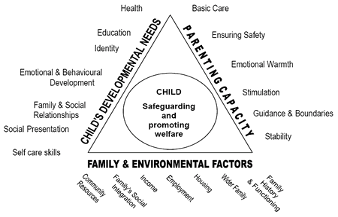
Working together they hold the domains of the Parenting Assessment Triangle (NCERCC think Scotland’s GIRFEC model is holistic and practical)
The Triangle is a simple way of representing the three domains that assessment should take account of: The parents’ or caregivers’ capacities to respond appropriately Each domain relates to the others. Any child’s development is significantly shaped by both their particular experiences and the interaction between a series of factors.
The framework is based on legislative foundations and requires a thorough understanding of:
- children’s developmental needs
- the capacity of parents and carers to respond appropriately to these needs
- the impact of wider family and environmental factors on parenting capacity and children. The model below shows these three inter-related systems.
If we define parenting as caregiving to one’s child, then the best parent is not the one who parents most, and certainly not the one who parents least, but the one who parents just the right amount. That’s the parent Goldilocks would pick, if she had tried out three different parents along with the three different bowls of porridge, chairs, and beds. It’s the one most children would pick if they had the power to choose
Be good-enough parents
The good-enough parent is one who makes active adaptation to the child’s needs, an active adaptation that gradually lessens, according to the child’s growing ability to adapt and to tolerate frustration
‘Good enough’ parenting encompasses being sensitive, warm and empathic, being physically and emotionally available, and meeting needs responsively. It also involves providing a nurturing environment where a child feels safe, contained and held – literally and emotionally. To be good enough in these ways requires an ability to be adaptive to the spontaneous experiences of a child.
Related Posts