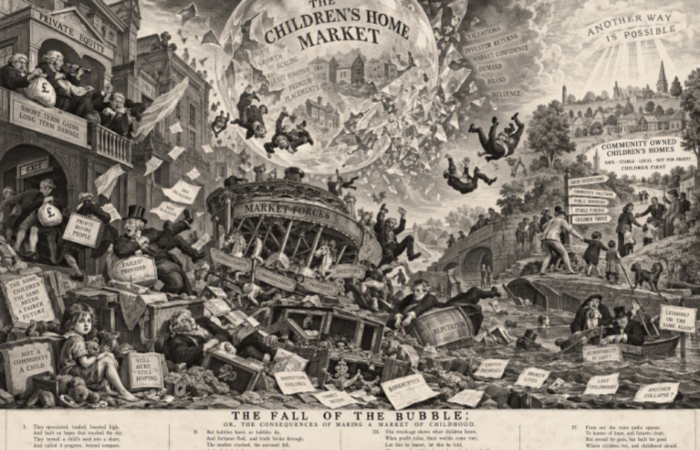
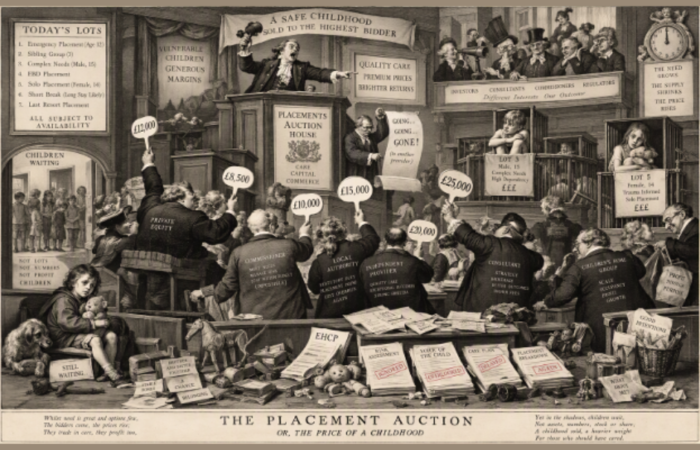
...accepting we, still, don’t know as much as we think we do accept that we,…

Memory Matters To Create a Future Invest in History in Memory
On 2 occasions recently NCERCC has been given opportunity to appreciate the importance of memory and history. Both have shown the role of historian has potential to steer the residential child care of the present and future.
NCERCC recently responded to a Sunday newspaper article (see below for details) about building extensions to enable foster carers to take more children. The scheme is called Room Makers.
The Minister for Children was quoted extensively. It was apparent he thought it new and innovative.
But is it?
The irony is that such Room Makers ‘fostering’, as described in the Observer article, is exactly residential child care.
This is not a claim, it is a solidly evidenced fact; see the youtube Housemother; read ‘Growing up in groups’ by Barbara Kahan in 1994, a government review and publication; and in any history of residential child care; see Children’s Homes website for accessible and encyclopaedic examples of the varied way residential child care has been provided and, or delivered.
Such ‘family group homes’ were relatively common in the 50s and 60s operated by married couples and providing care to up to as many as six children. Most received assistance in their caring responsibilities from support staff.
These homes, in themselves were preceded by ‘cottage homes’, teams of adults caring for small groups of children, sometimes siblings and frequently in clusters in a single location.
The transition to the creation of smaller children’s homes, initiated by residential workers, followed a series of scandals and enquiries associated with the abuse of children in large, institutional homes. The move to smaller homes started in the 70s has continued.
The move was part of a move for deinstitutionalisation. It is ironic one of the factors for this move was the size of the group and the potential for safeguarding incidents between children, and by carers, as well as increasing time and space for positive individual attentiveness by carers.
Another irony is that the Minister, Josh MacAllister, is responsible for the government’s commitment to the UN deinstitutionalisation charter.
The irony continues in that today there is a drift to accommodating, not the same as caring for, larger groups in fostering and supported accommodation. In the latter, Ofsted have reported children placed whose needs were bigger than, and inappropriate for, solely place-based decisions with minimal or no adult presence, and were in need of the safeguarding of themselves and others.
It is inescapable to consider that cost affects care and safeguarding. If it does not then how to account for ‘best value’ prioritised in tenders, with price outweighing quality? Even everyday needs are affected, such as being able to talk with a ‘parenting’ figure offering advice and experience of friendships or budgeting and finances. Children need parenting, they cannot parent themselves. Groups of children need careful selection and bespoke support. The focus has to be needs not numbers, heads and beds.
The care of children needing residential options though, based on the concept of good-enough parenting, requires informed reflective, skilled, experienced, emotionally intelligent professionals. Love is a pre-requisite, but it is not enough to meet the needs of children with high level, multiple, co-occurring social and psychological behavioural and emotional needs.
There are implications should ‘fostering homes’ become larger in capacity than residential child care options. If so, should it not be registered as a children’s home and have the Quality Standards for children’s homes applied? It is ironic that Ofsted could not, without regulatory changes register group fostering as a children’s home due to inadequate staffing. A children’s home could not accept both babies and children up to 18 years of age, as stated was happening in the article about the fostering setting. The protective reasons for these and other factors are well established and the basis to current law, regulation and best practice.
It is worrying then that the Minister calls for ‘flexibility’.
Exceptions and exemptions should not be made, we know from historical incidents where they lead. The basis of our children’s legislation is founded on the lessons learned from traumatic and tragic events. We do not need to repeat them is the message to new Parliamentarians who may be pressured to vote through the Children’s Well Being and Schools Bill and who do not know the history, or not had it explained by the Minister. It is essential policy makers know their history.
This development of fostering is presented as innovation. Government commonly speak of a desire to go ‘further and faster’. In this case government is turning the clock back. Back to the future!
The DfE invest substantially in behavioural psychological economic nudges. Clearly, from all as laid out above, an investment in a children’s social care historian has potential to save money and provide experience-informed policy advice. There is a reason we stopped doing exactly the things the government now plan.
There is a further important matter to be observed, the importance of memory, remembering our history.
We are all pioneers with every child, but we stand on the shoulders of giants of those who preceded us in working with and for children.
We need to know and use our history. The dazzle of things ‘innovative’ needs the sobering of historical precedent so as to avoid problems, known before and overcome, arising again.
Innovation is an act of belief as much as science. Because history is insufficiently studied there is potential for the same mistakes being repeated. Anything hailed as innovation requires, and children deserve, historical scrutiny. History can teach us to avoid strategic miscalculations.
Memory matters. To create a future, invest in history, in memory.
Newspaper article reference: https://observer.co.uk/news/national/article/all-children-need-loving-lifelong-connections-thats-what-foster-care-is
The above response is an example of the work of CHIEF.
(Children’s Homes Information and Evidence Factchecker).
NCERCC started CHIEF last year in a low key way to see if such a service was needed and if there was enough call. We have established there is a need, and now we are working on getting people to know more about CHIEF.
NCERCC – independent experts in Residential Child Care and its planning, experienced knowledgeable informed, with decades of experience in children’s social care theory and practice, policy and research
Related Posts