...accepting we, still, don’t know as much as we think we do accept that we,…

Transforming Care and Relationship-based Commissioning
We need to step back ‘from a way of acting or reacting’ and to engage in the development of the given into a question’. In doing so we can see that ’things are not as self-evident as one believed’.[1]
How many times have those of us involved with commissioning been in discussion about innovation only to find it is yet another tweak of what already exists.
Every time we quote this people smile in recognition:
[1] Foucault M 1988 Politics, Philosophy, Culture, Interviews and Other Writings, 1977-1984

Everyone knows we need to ‘do different’. The main obstacle is that the government agenda is not different or radical. The many reasons for this can be considered another time.
Being radical would be to engage in different ways of thinking about children, producing different ideas about childhoods, leading to different provisions for children and different ways of working with children.
When a different child comes into view with different constructions of public provision, and so too does a different worker.
NCERCC agrees with the observation of Petrie and Moss[1] that in England public provision, in our case, Residential Child Care, is primarily concerned with regulation, surveillance and normalisation. The care we offer is instrumental, towards specific, predetermined outcomes.
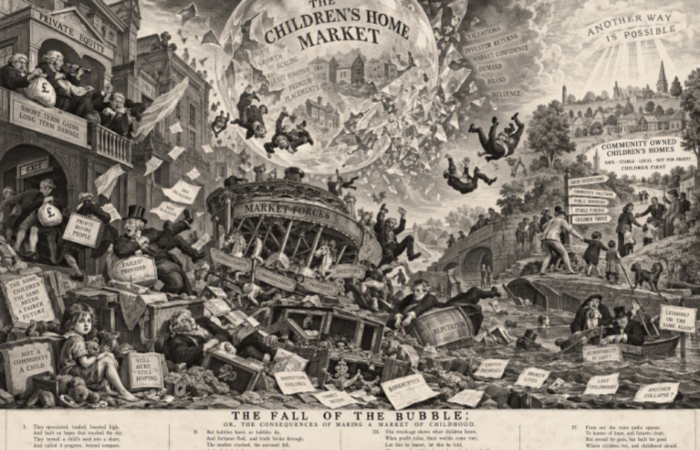
Another social construction is possible; ‘children’s spaces.
- A cultural space where values, rights and cultures are created.
- A discursive space of differing perspectives, forms of expression, where there is dialogue, confrontation is valued as an exchange of experience and views, where there is deliberation and critical thinking.
These things are a long time absent from discussions in England about children in care. Look at conferences and we see expositions of how to do things a certain way, manualised learning. Critique and exploration have been missing for a long while and we, and children, are poorer for it. We need to find the ways to talk, again, about different cultural, social, economic, political, ethical, aesthetic, physical, possibilities.
A small first step might be taken by reading Theses on the transformation of children’s care commissioning by Jonathan Stanley, Principal Partner NCERCC, and Kathy Evans, CEO Children England at the time of writing (now Director of Policy and Influencing at NYAS) first drafted these in 2020.[2]
A second step might be taken by looking outside of the children’s services bubble. Here’s an example.
Transforming Care and Relationship-based Commissioning
In 2015 NHS England, ADASS and LGA published the National Service Model as part of the National Transforming Care Plan. The vision is of a whole-system response to delivering high quality services and support for people. The National Service Model refers to the need for ‘capable environments’ which are characterised by, among other things, positive social interactions and support to maintain relationships. A quote from a commissioner sums this up: “The success in this lies not within systems and processes but within human connections, commitments, accountability and sustainable relationships that are non-adversarial.”
This is described in the IPC report Transforming Care and Relationship based commissioning.[3]
Here, providers and commissioners agree that relationship-based commissioning makes better use of finite resources; encourages innovation; allows safe places to share positive risk taking; creates greater flexibility and hence facilitates market shaping.
What is Relationship-based Commissioning?
It is a collaborative way to provide complex responses to small numbers of people (and their families) with fluctuating needs.
This requires commissioners to work with a small group of providers with specialist skills.
Trusting relationships enables the maximising of flexibility to meet such fluctuating (at times even erratic) levels of need.
At the heart of relationship-based commissioning is the idea that we do our best work and hence achieve the best outcomes with people when we have good relationships.
Good relationships are built on good rapport, warm, attentive and easy to relate to.
A bureaucratic, complicated or challenging system erodes rapport.
Positive aspects on the Rapport building scale
5 – Support, trust, sense of being positively ‘connected’ in some way.
4 – Strong sense of knowing, the familiar.
3 – Genuine warmth, kinship.
2 – Comfortable, familiar.
1 – Some warmth.
Transforming Care findings include
- Describe the strategic needs of the cohort you are focusing on – don’t just write a specification.
- Remember price whenever it enters into the equation deletes quality – separate them.
- Empower providers – don’t make them compete – once you have your collaboratively agreed framework forget the scattergun approach to referrals.
- Using trend forecasting is to be assessing with a purpose and being realistic about the long lead in time. Don’t expect providers to be able to set up a new service immediately.
- Write shared development plans – good providers are not sat ready and waiting with voids to fill and staff teams twiddling their thumbs. They deliver person centred services, and these take time to design and staff teams take time to recruit. Therefore, be realistic about timescales. It takes 6 to 9 months at least to set up a new service, and 5-7 years for it function optimally.
- Agree contingency plans for fluctuations in need. This may include a contingency budget for any increase in support needed for a crisis or to maintain a placement. If the budget is not used, it is repayable to the commissioner.
Fundamentally this shows using sufficiency is to misdiagnose the problem – the focus needs to be specificity.
Further reading
The following NCERCC resources come high up in web searches.
https://ncercc.co.uk/developing-relational-commissioning-1/
https://ncercc.co.uk/developing-relational-commissioning-5-barriers-to-implementing-a-new-approach/
[1] From Children’s Services to Children’s Spaces: Public Policy, Children
[2] Theses on the Transformation of Children’s Care Commissioning – NCERCC
Related Posts